Showing posts with label new york times. Show all posts

Thursday, May 8, 2008

The wine dilemma


Excellent piece in the NYT today by wine writer Eric Asimov about the motivations behind the choices of wine drinkers. He delves into recent research and soon-to-be-released books, some of which asserts that American wine drinkers are a big manipulative herd and, if tasting blindly, will often prefer the cheap plonk over the expensive bottle.

I've thought a lot about this too. I've wondered if I were given a glass of a $150 St-Emilion Grand Cru and one of my usual $7 cheapie Italians, would I be able to taste the difference? Well, I goddamn hope so. I've always assumed I could because St-Emilions have, in the few times I've drunk them, typically blown my mind. They're so elegant while my cheap Italian is so, well, servicable, amusing but ultimately, the work of a hack. It would be like comparing any nuanced performance by Juliette Binoche to Al Pacino from Scent of a Woman. Question is, could I notice the difference between, say, a $50 Cab from California and a big-tasting red from Argentina that was one-fifth the price? Dude, I only scored something like a 5/20 on guessing the Asian ethnicities of people in photos on alllooksame.com. I doubt I could be more discerning with wine.

This is the kind of taste test that Asimov is describing that is the basis of a book that's coming out later this month called The Wine Trials, which apparently concludes, among other things, that Americans can't tell the difference between expensive and cheap wines. Fair enough. The next real question is this: Who the fuck cares? I agree with the general public that wine marketing is manipulative, that the perceptions we have about price and quality are often out of whack with what we're served, and that we all are afraid of ordering the cheapest wine on the menu. But it's time the consumers take back control and books like The Wine Trials should form a wakeup call to us casual low-knowledge drinkers. In the past 15 years, wine consumption in the U.S. has grown more than 50% and still, despite the fact that we've become way more familiar with the stuff, Americans (and I think we in Canada fall in the same lot) are still really insecure about their own preferences. This is the conclusion that Asimov comes to and I totally agree.

Rather than call ourselves dupes, we consumers should take the high road unabashedly embrace what we do and don't like. If you're a fan of 4L jugs of Carlo Rossi, go ahead and lap it up. If you like $150 Burgandy from Beaune over the half-as-expensive Barone, good for you. It's books and articles like this that get me riled up in thinking that, for some reason, when it comes to wine, we never trust what our tongues tell us. It's about time we do. Only then can we force the wine press to start talking in a way that we all can understand and in a way that will encourage casual discussion. Talking about wine should be no different than how 15 year-olds debate the differences between a Big Mac and a Whopper. (For the record, I was a Quarter-Pounder-with-bacon-and-cheese man myself.)

Thursday, January 31, 2008

On tapas and yuzu ponzu.


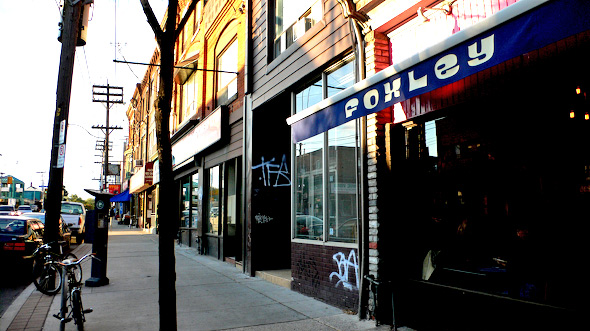
I know I'm way late on this one but I finally checked out the much-raved Foxley resto (207 Ossington, Toronto) for the first time yesterday. I normally detest the whole tapas thing – especially pan-Asian tapas, which more often seems like bad Chinese-lite. Going for Asian tapas to me is like thirsting for a pint of beer but being asked to make do with a teacup of Miller Lite followed by a thimble of Michelob. I have to admit, though, I was thoroughly impressed.

Two dishes worth talking about: First, the artic char ceviche ($15) which was loaded with lime juice and chili sauce and topped with klumquats. Sounded great on the menu, and tasted fantastic – if you ate the klumquats separately. They were just too overpowering. I admit the words "ceviche" and "klumquat" on the menu caught my eye (and also the eye of my dining companion) and we were instantly sold upon reading about the item. But the dish would have been perfect without the fruit. And so I thought about the chef's conundrum: Do you always have to have that go-the-extra-mile twist to upsell your customers, even when a humbler and simpler version would work just as well, if not better? In chef Tom Thai's defence, I'll assume he stands by his dish thinks it kicks ass. I wish it did for me, but unfortunately, it didn't.

The standout dish? A Japanese-style grilled mackerel in a yazu ponzu sauce ($8). This was simple made divine – you really can't get more humble than a mackerel fish (which also happens to be one of my favourites) and for this dish, it was simply grilled, then topped with a few finely chopped chilis and lightly bathed with a yazu ponzu sauce – a lemony-like light soy. It was the best east-meet-west dish I've eaten in a long time and yet, so elegantly simple. Grilled mackerel always makes me think of Portugal (where they eat the stuff by the ton, always with boiled potato) and this dish combined the smoky taste of grilling with the light uplifting citrus notes of yuzu ponzu. I plan on replicating this along with the yuzu ponzu at home.

One last thing about tapas: If you haven't read the New York Times piece from early Decmeber about how the tapas trend is killing the entree, you really ought to. Unfortunately for me, I'm one of the few diners who still loves the meat+starch+veg combination (likely because growing up in a Chinese family, I rarely ate that way), but that's a whole topic for another day.

Monday, December 17, 2007

Feast as performance art

Interesting read in the NY Times about how the art set celebrate the holidays.

Agathe Snow is an artist whose latest work looks like a pile of dumpster refuse that serves as a comment on... well... whatever. More interesting to me is that she's apparently a good cook and invited her artist-friends to pig out for an event she dubbed the Fist Postapocalyptic Christmas Dinner.

First, the visual: in the entryway, an installation of jarred potions, oils and jams. Off-kilter cookies tumbled out of a Joseph Beuys-worthy suitcase. In the main room, a table fashioned from upended bookshelves was covered end to end with food in mismatched pots, pans and trays, while an explosive centerpiece assemblage underscored the evening’s the-end-was-near theme. Every few minutes, another riotously garnished dish appeared: goose stuffed with kale, a glossy ham, Campari-cranberry relish, green eggs, a terrine of chicken-liver pâté, poussin with garlic and pears, roast quail, empanadas, leg of lamb, a tray of beef shanks . . . wild rice with pomegranate, lentils, sweet-potato purée, cauliflower-eggplant gratin . . . rough-hewn breads. The volume of food became a performance in itself.

Sounds like an orgy of consumption. Given the fact allusion to the apocolypse in the title of the event, you'd imagine something a bit more stark, bleak and far less decadent. The apocolypse? Party on, apparently.