Thursday, May 8, 2008

The wine dilemma


Excellent piece in the NYT today by wine writer Eric Asimov about the motivations behind the choices of wine drinkers. He delves into recent research and soon-to-be-released books, some of which asserts that American wine drinkers are a big manipulative herd and, if tasting blindly, will often prefer the cheap plonk over the expensive bottle.

I've thought a lot about this too. I've wondered if I were given a glass of a $150 St-Emilion Grand Cru and one of my usual $7 cheapie Italians, would I be able to taste the difference? Well, I goddamn hope so. I've always assumed I could because St-Emilions have, in the few times I've drunk them, typically blown my mind. They're so elegant while my cheap Italian is so, well, servicable, amusing but ultimately, the work of a hack. It would be like comparing any nuanced performance by Juliette Binoche to Al Pacino from Scent of a Woman. Question is, could I notice the difference between, say, a $50 Cab from California and a big-tasting red from Argentina that was one-fifth the price? Dude, I only scored something like a 5/20 on guessing the Asian ethnicities of people in photos on alllooksame.com. I doubt I could be more discerning with wine.

This is the kind of taste test that Asimov is describing that is the basis of a book that's coming out later this month called The Wine Trials, which apparently concludes, among other things, that Americans can't tell the difference between expensive and cheap wines. Fair enough. The next real question is this: Who the fuck cares? I agree with the general public that wine marketing is manipulative, that the perceptions we have about price and quality are often out of whack with what we're served, and that we all are afraid of ordering the cheapest wine on the menu. But it's time the consumers take back control and books like The Wine Trials should form a wakeup call to us casual low-knowledge drinkers. In the past 15 years, wine consumption in the U.S. has grown more than 50% and still, despite the fact that we've become way more familiar with the stuff, Americans (and I think we in Canada fall in the same lot) are still really insecure about their own preferences. This is the conclusion that Asimov comes to and I totally agree.

Rather than call ourselves dupes, we consumers should take the high road unabashedly embrace what we do and don't like. If you're a fan of 4L jugs of Carlo Rossi, go ahead and lap it up. If you like $150 Burgandy from Beaune over the half-as-expensive Barone, good for you. It's books and articles like this that get me riled up in thinking that, for some reason, when it comes to wine, we never trust what our tongues tell us. It's about time we do. Only then can we force the wine press to start talking in a way that we all can understand and in a way that will encourage casual discussion. Talking about wine should be no different than how 15 year-olds debate the differences between a Big Mac and a Whopper. (For the record, I was a Quarter-Pounder-with-bacon-and-cheese man myself.)

Wednesday, May 7, 2008

A vote for hock


As I type this, I've got a pot of soup with smoked ham hocks and lentils simmering away. Imagine Quebec-style split pea soup, only with brown lentils instead of yellow peas, and a ham hock instead of regular ham.

Pity the hocks. They're only one vowel away from a derogatory word we call ruralfolk and their appearance and origins – hocks are the just inches away from feet - make many squeamish. But before you write it off, try some. Ham hocks are really damn good. Southerners know about this well. They'll add it to collard greens to make the stuff from something healthy to something, well, typical Southern. Chef Frank Stitt elevates the lowly hock in a recipe that combines asparagus with a ham hock vinaigrette. Add them to anything with beans to elevate them to an ethereal level. Do it. This is not just like adding bacon to a dish to give it that dash of porky smoky flavour. Hocks are a whole other level of kickass – they release a ton of collagen and fat as you cook them, so everything in your pot gets a nice sheen, meaty thickness and a deep deep flavour. Go hicks. Er, I meant hocks.

Monday, May 5, 2008

On the virtues of eating early.


I grew up in a small town where the men worked strictly 9-to-5, the commute was never more than 15 minutes from work to home and there was always a woman at the house making dinner. And because of these three factors, the people in my town always ate at 5:15pm – the moment that the dad got out of his truck and into the house and grunted his way to the head of the dinner table at which point the pork chops were lifted from the oven and the apple sauce was finished. (From what I gathered, most of my friends spent their entire youth eating pork chops and apple sauce.)

My house was an exception. My dad worked a bit later – he started around 9:30 and didn't come home 'till 6pm – so we didn't eat until almost a full hour after everybody else in the town. This affected my social life greatly: My friends would often call me around 6:30 on a Friday night to ask me what I was doing but I'd have to tell them I was still eating and hadn't thought that far. My parents were pissed that I had to answer the phone during dinner; my friends were pissed not knowing if I was going to join them or not.

But as late as I thought we ate, I learned early that 6pm for dinner was hardly custom for the cityfolk. Whenever we'd come to Toronto to visit our relatives, I starved. Uncles didn't get back from work until 7 or 7:30pm, which meant dinner could be as late as 8pm. This was an annoyance to me at first, but after a few days, I kinda liked it. It meant one could watch all the sitcom reruns AND the sports highlights of the evening news BEFORE dinner. How cosmopolitan.

After I finished high school, I lived in a couple small towns in France for a year as an exchange student, staying with host families. There, I ate at 7:30pm, but it didn't seem to bother me because I always ate a gigantic and delicious lunch at the cafeteria of my lyceé. (Cafeteria food in France, with its three courses - salad, main and cheese – and limitless baguette was the best part of my day.) Then after France, I lived in a dorm for a year where I regressed a bit to my provincial ways. Dinner service started at 5pm and I would usually line up before the doors to the cafeteria opened. Going at 5pm meant you could get the greatest choice – the more favourite dishes would sell out by 6pm – and make sure you got a warm plate that wasn't sitting on a steam table for too long. Also, it meant beating the post-Simpsons rush (there were twenty dudes who routinely watched the Simpsons at 5pm, thus creating a logjam in the lines at 5:30).

After my freshman year, I then lived on my own, at which point the whole idea of a regimented meal plan went out the window. I'd eat as early as 4:30 and as late as 10pm, depending on when I woke up, how much I snacked and how much I had or planned to be drinking. My dinner life didn't become regimented again until after I graduated and started my first job. I moved to Toronto to work at a magazine and I moved in to my grandparents' place where my grandma ensured I had at least five dishes to choose from – old-school Cantonese – at 7:30pm. I'd eat till I'd burst, go out and meet friends and drink five pints and wonder why I'd feel so bloated that night. Unsurprisingly, I gained ten pounds during my stay chez granny.

A year later, I moved out of her house and lived on my own, and for the following four years, I had to adjust to the dual responsibility of working a job with a long commute and feeding myself – a combination of circumstances that were far more difficult to grasp than I thought. I rarely ate before 8pm and most often around 9pm or later (depending on the number of aperatifs drunk). I'd end up consuming a large amount – I'd be ravenously hungry by that time, not having eaten since lunch. Afterwards, I'd feel sluggish, tired and often fall asleep reading a magazine or watching half a movie. Worst of all, I'd wake up late not feeling too hungry (even if slightly hungover) and skip breakfast. And of course, given my rural roots, I thought I was so urbane and mature for eating so late. Me so cool.

A few years later, my supposed sophitisticate lifestyle changed, though not through any deliberate intent. It happened a bit unintentionally. In 2005, I started working from home, and cooking became a great excuse to quit working or procrastinate. And there's something about being at home all day that makes one hungrier than usual. By the fall of that year, I found myself resorting to the my high school habits. I had, once again, started eating at 6pm. At first, I made fun of myself for doing so but after a few times, I got the hang of it and I liked the routine of it all. Finally, I was eating like a real adult. Or, as others would prefer, like a geriatric.

Of course, there are a few exceptions to this rule: During baseball season, where I co-ordinate my meal with the first pitch of the Jays game, which almost is 7pm most of the time. Also, I realize that it's not very couth or sexy to suggest a dinner date at 6pm, so I will schedule accordingly if entertaining. And, of course, restaurant meals are always made later – eating at 6pm at a nice restaurant almost always means you'll be sitting in a half-empty room populated with seniors and waiters who are anxious to get you out to ensure the reservations at 7:30 will be seated in time.

Still, when eating at home, I adhere to my 6pm routine. Cosmopolitanism be damned: I love eating early. It frees up more time in my evening. It's healthier for me (apparently) and it makes me hungrier in the morning, which means I'll eat breakfast (not always evident in my undergrad and post-grandma years). And it prevents from snacking in the afternoon.

Would I reconsider this routine and shift dinner back a couple of hours? If I lived in France again, sure. If I lived in Spain where tapas is a viable snacking options, absolutely. And what if I got a job with a long commute or late hours? Damn. I dunno. I won't take the job, I guess.

Happy Cinco de Mayo!


Fiesta time people.

Check it out: I made some mole poblano and wrote about it for the National Post.

What wasn't included in my column was the aftermath. I actually made an excess of mole sauce, so the next day, I cut up some pork shoulder, browned it and braised it along with the remaining mole. A few hours later, I placed the pork on some warmed tortillas and some salsa fresca. Result: Bueno.

Naturally, given how many expat Latinos there are in the U.S., the New York Times is flogging its archive of Mexican recipes in name of the holiday.

Friday, May 2, 2008

Where have I been?

Admittedly, it's been way too long. First, some housecleaning and updates on what I've been doing lately:

- A Passover-themed Ingredient column about schmaltz, as in the chicken fat, not the senimental kind.
- An Easter-themed Ingredient column about Zurek, the Polish easter soup
- A short feature on the difficulty that chefs have describing their dishes on menus.

Saturday, February 23, 2008

Coffee on your steak


Here's the video of Trish Magwood demonstrating how to make an easy chili coffee steak rub.

And here is my Ingredient column on the subject.

Wednesday, February 13, 2008

You are what you drink


I wrote about the trials of ordering wine while on a dinner date for today's National Post. Check it out here. And thanks to Steve Murray for the illusration.

A few things I learned while researching the story:
- Ordering wine while on a date still remains a male responsibility.
- Avoid the big tannic reds on first dates. Too heavy and it'll stain your teeth.
- Champagne! Couldn't fit this detail in the story but Mark Taylor, sommelier and owner of Cru restaurant in Vancouver tells me it's always a crowd-pleaser. A bit celebratory, but it always sets the mood right.

A logical follow-up story on this topic would be how we all judge dinner-guests based on what wine they bring. I'm hardly a wine snob (I love <$10 Italians) and I won't turn away a guest at the door if they bring an offensive wine, but if someone shows up with Yellow Tail or Jackson Triggs, they will be barred from future dinners. Harsh? Perhaps, but someone's gotta set the standards.

Saturday, February 9, 2008

Ingredient - the video


I've always wanted to have a video demo accompany my Ingredient column in the National Post. Finally, my team and I have finally completed our first one. I invite you all to check it out and tell me what you think. The video is about my guided tour of the fish counter at T&T Supermarket and a quick demo about how to make Cantonese-style steamed green bass. You can also read the column here.

Thank you to producer Maryam Siddiqi for making this project happen.

Friday, February 8, 2008

Allez cuisine! The Gold Medal Plates black box competition

Last night, I attended the first night to the The Gold Medal Plates competition. Part culinary triathlon, part Olympic fundraiser, the GMP is a meeting of seven top chefs from across the country and they duke it out over three days in a series of challenges. The first event was yesterday's Iron Chef-like black box competition: The chefs are handed a mystery box of six ingredients and then given ten minutes to devise a menu of two dishes that use all the ingredients. They then announce their menu, submit it to the judges (comprised of food writers and chef-instructors), and create two dishes within the one-hour time limit.

James Chatto, food critic for Toronto Life, is the head judge of the competition and was responsible for choosing the six mystery ingredients. Five of them were local – organic flank steak, Georgian Bay whitefish, celery root, honeycomb and Ontario-grown peanuts – and one was the exotic import – plantains. Why this combination? "I wanted to make it difficult but keep it local," he said. "I added plantains because it can be both used as something sweet and as a starch." One of the competing chefs – Paul Rogalski from Rouge in Calgary – announced he had a peanut allergy upon declaring his two-dish menu. I asked Chatto later if he ever thought of the nutaphobes in his ingredient-selection and he blushed a bit. "It never crossed my mind."

The event took place at the culinary school at George Brown College. There were about 50 guests and judges, crammed into the school's kitchens, watching the chefs sweat out the challenge. It was like watching Iron Chef live, sans commentary and multiple camera angles, so it was a bit difficult to see what was going oe. Also, there were a throng of chefs, restaurateurs and foodie hanger-ons who were more amped about the free wine than about watching the competitors sweat it out, which made it even more difficult to decipher what was going on.

The chefs who took part:

· Anthony Walsh of Canoe (Toronto)
· Martin Ruiz Salvador of Fleur de Sel (Halifax)
· Roland Ménard of Manoir Hovey (Montréal)
· Melissa Craig of Barefoot Bistro (Vancouver)
· Paul Rogalski of Rouge (Calgary)
· Judy Wu of Wild Tangerine (Edmonton)
· Michael Moffatt of Beckta Dining and Wine (Ottawa-Gatineau)

Check out my preview of the GMP competition.

Also, here's a video of Anthony Walsh declaring his menu after his ten minute brainstorming period.

Sunday, February 3, 2008

Gong hay fat choy

Is the myth of the second Chinese-only menu at Chinese restaurants truth or fiction?

Truth indeed. Check out my story about it here. Truth be told, I've been meaning to write explain the secrets of the second menu for a while and it just so happened that my editors have been just as eager to read about now.

A few footnotes:
- the Chinese-only menu is called "to chan" and prounanced "TOE chan." If you want to see the menu, ask for the "TOE chan DAN."
- Unfortunately, I didn't get to lament the sad state of North American Chinese cuisine. Chinese cuisine on this continent needs a massive marketing overhaul but it's so hard to find at times. Nina and Tim Zagat – the founders of the Zagat guides – complained about the how far North American Chinese food lags the real thing.
- My dad has yet to give me his opinion of what I wrote.

Thursday, January 31, 2008

On tapas and yuzu ponzu.


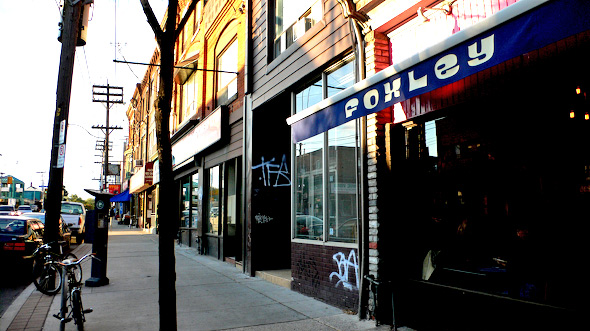
I know I'm way late on this one but I finally checked out the much-raved Foxley resto (207 Ossington, Toronto) for the first time yesterday. I normally detest the whole tapas thing – especially pan-Asian tapas, which more often seems like bad Chinese-lite. Going for Asian tapas to me is like thirsting for a pint of beer but being asked to make do with a teacup of Miller Lite followed by a thimble of Michelob. I have to admit, though, I was thoroughly impressed.

Two dishes worth talking about: First, the artic char ceviche ($15) which was loaded with lime juice and chili sauce and topped with klumquats. Sounded great on the menu, and tasted fantastic – if you ate the klumquats separately. They were just too overpowering. I admit the words "ceviche" and "klumquat" on the menu caught my eye (and also the eye of my dining companion) and we were instantly sold upon reading about the item. But the dish would have been perfect without the fruit. And so I thought about the chef's conundrum: Do you always have to have that go-the-extra-mile twist to upsell your customers, even when a humbler and simpler version would work just as well, if not better? In chef Tom Thai's defence, I'll assume he stands by his dish thinks it kicks ass. I wish it did for me, but unfortunately, it didn't.

The standout dish? A Japanese-style grilled mackerel in a yazu ponzu sauce ($8). This was simple made divine – you really can't get more humble than a mackerel fish (which also happens to be one of my favourites) and for this dish, it was simply grilled, then topped with a few finely chopped chilis and lightly bathed with a yazu ponzu sauce – a lemony-like light soy. It was the best east-meet-west dish I've eaten in a long time and yet, so elegantly simple. Grilled mackerel always makes me think of Portugal (where they eat the stuff by the ton, always with boiled potato) and this dish combined the smoky taste of grilling with the light uplifting citrus notes of yuzu ponzu. I plan on replicating this along with the yuzu ponzu at home.

One last thing about tapas: If you haven't read the New York Times piece from early Decmeber about how the tapas trend is killing the entree, you really ought to. Unfortunately for me, I'm one of the few diners who still loves the meat+starch+veg combination (likely because growing up in a Chinese family, I rarely ate that way), but that's a whole topic for another day.

Tuesday, December 18, 2007

What? No gizzards?


Funny story I found today about people buying turkeys and - to their horror! - not getting the little package of turkey organs inside the cavity to use for their gravy.

Ah, gravy. I admit I'm a sucker for anything covered in gravy: The sides can be cold and the meat can be dry, but as long as there's good hot gravy, then it really doesn't matter. If it says gravy on the menu, I'll order it. (Chicken fried steak with cream gravy? Yes, please!) I love white gravy, dark gravy, gravy with onion mix, coffee red-eye gravy, and tomato gravy. And who can forget the heavy significance of Stephannie's gravy fantasy from last year's Survivor? Poor Stephannie. In the middle of the competition, the girl mentionned she'd die for a plate of mashed potatoes and gravy after days of jungle crap. Who could blame her? But her tribemates interpreted the comment as a sign of weakness and voted her off that same episode. The lesson: Gravy is a temptress, a fantasy, a powerful dream that can make your mind wander from the task at hand.

But back to giblets. I like the idea of giblets in gravy, though I've yet to try it out. Last time I made turkey – a gigantic feast for 15 animals (uhh, friends) who left my kitchen looking as if I had invited Charles Bukowsksis and Jim Harrison for an eating and drinking contest – I ended up using the remaining drippings and spiked it with chicken broth and thickened it with a cornstarch slurry. Simple, yet effective. The evening was mentionned in a story I wrote for AOL Canada, which you can find here.

Monday, December 17, 2007

Feast as performance art

Interesting read in the NY Times about how the art set celebrate the holidays.

Agathe Snow is an artist whose latest work looks like a pile of dumpster refuse that serves as a comment on... well... whatever. More interesting to me is that she's apparently a good cook and invited her artist-friends to pig out for an event she dubbed the Fist Postapocalyptic Christmas Dinner.

First, the visual: in the entryway, an installation of jarred potions, oils and jams. Off-kilter cookies tumbled out of a Joseph Beuys-worthy suitcase. In the main room, a table fashioned from upended bookshelves was covered end to end with food in mismatched pots, pans and trays, while an explosive centerpiece assemblage underscored the evening’s the-end-was-near theme. Every few minutes, another riotously garnished dish appeared: goose stuffed with kale, a glossy ham, Campari-cranberry relish, green eggs, a terrine of chicken-liver pâté, poussin with garlic and pears, roast quail, empanadas, leg of lamb, a tray of beef shanks . . . wild rice with pomegranate, lentils, sweet-potato purée, cauliflower-eggplant gratin . . . rough-hewn breads. The volume of food became a performance in itself.

Sounds like an orgy of consumption. Given the fact allusion to the apocolypse in the title of the event, you'd imagine something a bit more stark, bleak and far less decadent. The apocolypse? Party on, apparently.

Saturday, December 15, 2007

Comer mangu de plantano.


My Ingredient column this weekend was about plantains and the Dominicain sidedish of Mangu, a mash of plantains that is served at breakfast with a Full Dominican breakfast (eggs and sausage - similar to a Full English) or as a starchy accompaniment for dinner.

I chatted with a few Dominicans about their cuisine and with one man, the conversation went from mangu to smoked pork chops to langoniza and finally to sancocho, the hearty stew that uses seven different kinds of meats. After expressing his delight over the heavy food – it's the greatest cure for a hangover, he tells me – he added that sancocho is an imperative part of the mating ritual of Dominicans. The three elements: First sancocho, add a bottle of rum and end with sex. "We call it the 1-2-3," he laughs. Stewed goat meat + pork ribs + rum = powerful aphrodisiac, apparently. I imagine the rum is the most important element.

Thursday, September 20, 2007

The baseball diet


Sitting behind the bullpen of a Blue Jays game this past week reminded me of an obvious fact that I had forgotten: Ball players are pigs.

Hardly a revelation, but the extent of a ballplayers' junk food snacking is beyond belief. There is no other sport where a player can indulge almost as deeply as a fan (minus the beer) during a game. Case in point: At a recent Jays game, rookie pitcher Brian Wolfe, from the dugout a pink Hello Kitty bag and within the first inning, a bored Brandon League dug into it for a bag of chips while half of the others were eating sunflower seeds and, later, beef jerky. In the bullpen, only the booze separates the players from the fans: The pros watch the game as leisurely as we do and stuff their faces like the rest of us.

Ballplayers are notorious for their poor eating habits though sportswriters, unfortunately, don't have the food-obsessed in mind to document the junky diets. But the question of what ballplayers eat has long interested me and it's why this feature about Mike Piazza and the 2002 New York Mets in the New York Times Magazine has stuck with me so long:

The clubhouse is designed to help the players relax and bond -- a cross between a frat house rumpus room and a Chuck E. Cheese's. But in the weeks I spent around the Mets, I witnessed little bonding amid the tubs of Bazooka bubble gum, packets of sunflower seeds, boxes of doughnuts, bags of chips, bottles of soda, beer, Gatorade, M&M's, Hershey bars, Power Bars, ice cream, pizza, pasta, ribs and macaroni and cheese.

Last month, I indulged my passion for baseball and junk food in one move, writing about Blue Jay relief pitcher Brian Tallet and his culinary adventures in making his own beef jerky. Check it out here. Included is a recipe to turn 21 lbs of inside round into beef jerky. How long does it last? "About two weeks." Pigs, I tell you.